

Engineered vs Solid Wood Flooring: Which Should You Choose
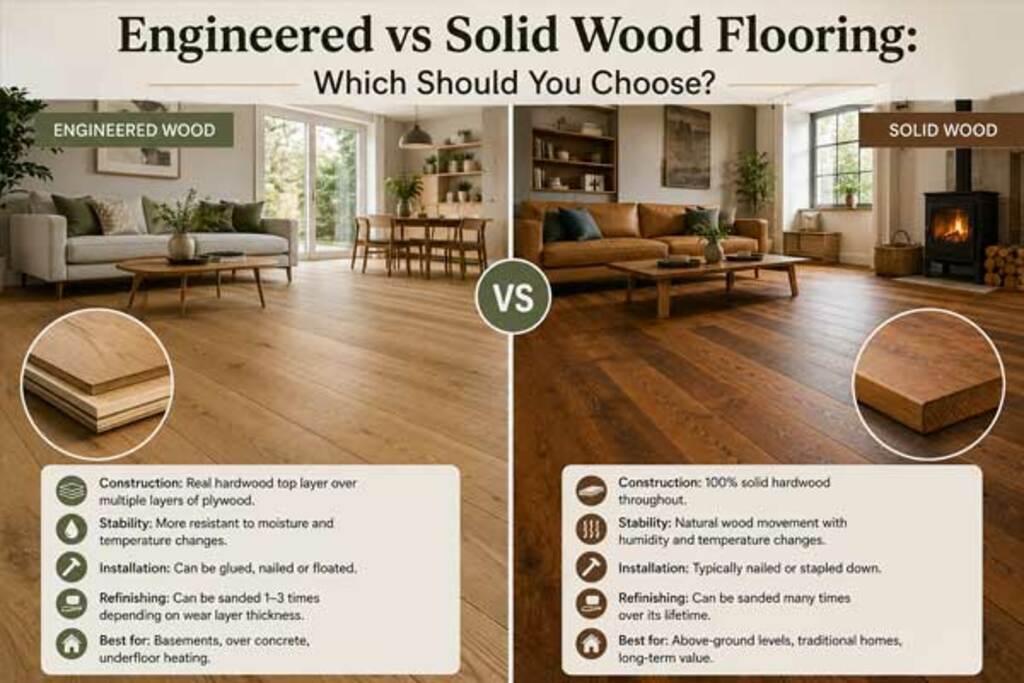 Engineered and solid wood flooring both use real timber, but they're built differently and perform quite differently as a result. Choosing between them is less about quality and more about which construction suits your installation conditions and the look you're after.
This guide compares the two across the factors that matter most: stability, installation compatibility, available finishes, repair potential and long-term value.
Construction and Stability
A solid wood floor is exactly that: a plank milled from a single piece of timber, typically 18mm to 22mm thick. Its advantage is depth of material, which allows multiple sandings over the floor's lifetime. Its limitation is that solid wood moves considerably with changes in temperature and humidity — expanding across its width in humid conditions and contracting in dry ones. Fitted in a poorly controlled environment, or in rooms with underfloor heating, solid wood can gap noticeably in winter and buckle in summer if the installation isn't right.
Engineered wood uses a real hardwood top layer (the wear layer) bonded onto a stable core of cross-banded plywood or HDF. The cross-banding counteracts wood's natural tendency to move, making engineered boards more dimensionally stable than solid wood across a range of temperature and humidity conditions. This stability is the main reason engineered wood is the more popular choice for both residential and commercial installations in the UK.
Wear layer thickness in engineered boards ranges from 2mm to 6mm. A 4mm or 6mm wear layer allows the floor to be sanded and refinished two or three times over its life. A 2mm wear layer typically allows one light sand at most. For a floor expected to last 30 or more years, a thick wear layer is worth specifying.
Installation Compatibility
Solid wood floors are generally limited to timber subfloors using nail-down or secret-nailing methods. Some solid floors can be glued to concrete subfloors, but that's more demanding and needs very careful moisture management. Solid wood over underfloor heating is technically possible but requires specific heating system types and tightly controlled temperature and humidity.
Engineered wood can be installed over both timber and concrete subfloors, using floating, glue-down or nail-down methods depending on the product and subfloor. It's compatible with underfloor heating in most cases, provided the maximum floor surface temperature of 27°C isn't exceeded. That broader compatibility makes engineered wood the practical choice in most modern residential construction.
Appearance and Available Options
Both solid and engineered floors offer the same range of species, grades and widths where the top surface is concerned. European oak, ash and walnut are available in both formats. The visual quality of the face comes down to species, grade and finish — not whether the board is solid or engineered.
Solid floors are generally available in widths up to about 150mm without significant additional movement risk. Wider solid planks exist but need careful management. Engineered boards come in much wider formats, from 100mm through to 300mm and beyond, because the plywood core reduces the tendency of wide boards to cup or gap.
Finishing Options
Both solid and engineered floors can be finished with the same range of products: hardwax oils from Osmo and Bona, and lacquers from Junckers, QuickStep and Morrells. Pre-finished engineered boards typically arrive with a factory-applied UV oil or UV lacquer that's very hard-wearing. Solid floors are usually supplied unfinished and finished on site.
- Solid wood: greater sanding depth, best for nail-down on timber subfloors, more movement-sensitive
- Engineered wood: more stable, wider installation compatibility, better for underfloor heating
- Wear layer of 4mm or more: key indicator of quality in engineered boards
- Junckers: leading solid wood floor manufacturer for UK residential and commercial use
- Pre-finished engineered boards: convenient and durable factory finish
For most UK residential projects, engineered wood is the more practical choice thanks to its installation flexibility and stability. Solid wood remains the preference for certain restoration projects, period properties where an authentic material matters, and sports floor applications where the Junckers solid system has an established track record.