

SPC Flooring Explained: What It Is and Why It Matters
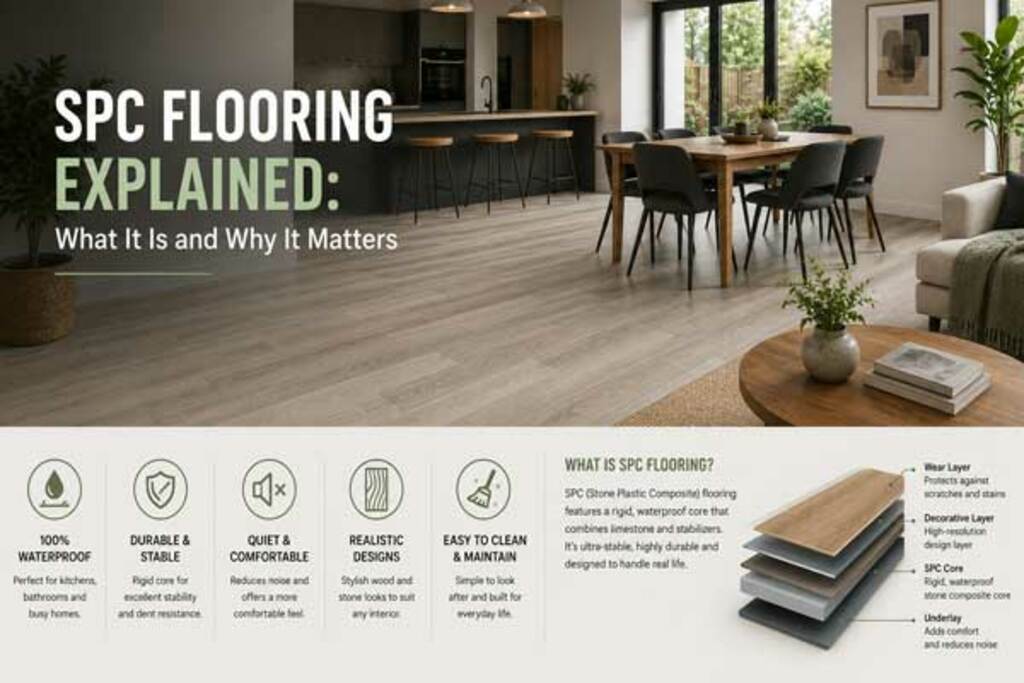 SPC flooring, short for stone plastic composite, is one of the fastest-growing flooring categories in the UK market. It's overtaken traditional flexible LVT in many retail settings and is increasingly the default specification for renovations needing a durable, waterproof, easy-to-install floor covering. Understanding what SPC actually is, how it differs from other products, and where it performs best helps you decide whether it's right for your project.
The SPC category emerged in the mid-2010s and has developed rapidly. Products considered premium just five years ago are now standard mid-market offerings, and the performance gap between budget and quality SPC has narrowed considerably.
What SPC Is and How It's Made
SPC has a rigid core made from a mixture of limestone powder, polyvinyl chloride (PVC), and stabilisers. This core is dimensionally very stable, doesn't expand or contract significantly with temperature changes, and is impervious to water. On top sits a printed design layer carrying the wood, stone or tile image, and above that a clear wear layer protecting the design from surface abrasion.
The rigidity of the SPC core sets it apart from flexible LVT, which uses a softer, more pliable core, and from WPC (wood plastic composite), which has a foamed core for extra cushioning. SPC is harder and denser than both, which affects how it feels underfoot and how it performs over slightly uneven subfloors — ranges like our Xylo Greenwich SPC and QuickStep Alpha Vinyl illustrate the format well.
How SPC Compares to Flexible LVT and Laminate
Flexible LVT is thinner, softer and more pliable than SPC, and generally installed with adhesive rather than a click system. It conforms closely to the subfloor surface, so minor unevenness reads through to the top. SPC's rigidity bridges minor subfloor imperfections more effectively, making it more forgiving in renovation projects where the subfloor can't easily be levelled perfectly.
Laminate flooring uses a photographic image layer on an HDF core, with a very hard melamine surface. Laminate has excellent surface hardness but isn't waterproof — water getting into the joints causes the HDF core to swell and fail. SPC is fully waterproof throughout its construction, making it appropriate for kitchens, bathrooms and utility rooms where laminate would be unsuitable.
Underfloor Heating Compatibility
SPC is compatible with both electric and hydronic underfloor heating systems, within the standard floor surface temperature limit of 27–28°C. The rigid core is less affected by heat than flexible LVT, which can soften slightly at elevated temperatures. It installs quickly with a click system and doesn't require the subfloor preparation or adhesive flexible LVT needs, which simplifies UFH installation projects considerably.
What SPC Does Well and Where It Struggles
SPC floors excel in renovation projects where speed of installation, waterproofing and budget all matter. A full room can be floored in a day without adhesives or complex preparation. The click system is forgiving for competent DIYers as well as professional fitters, and the waterproof construction makes it a genuine option for every room, bathrooms included.
SPC has a harder, more plastic underfoot feel than real wood or flexible LVT. In large, open areas it can also sound a bit hollow underfoot, particularly if the subfloor beneath isn't well bonded. Quality SPC products often include an attached underlay that addresses both the acoustic and underfoot feel issues to some extent.
- SPC is fully waterproof: suitable for kitchens, bathrooms and utility rooms
- Rigid core bridges minor subfloor imperfections better than flexible LVT
- Compatible with underfloor heating in most cases
- Installs quickly with click system, no adhesive required
- Harder underfoot feel than real wood or flexible LVT
- Look for attached underlay in premium products for better acoustics
SPC isn't a replacement for real wood, and the best products don't pretend to be. They're a practical, cost-effective, waterproof flooring solution that covers a lot of ground — literally and figuratively — in the UK residential renovation market. A product with a thicker wear layer, a quality design layer with a long repeat pattern, and an attached underlay gives the best results in practice.