

Your Complete Floor Buying Guide
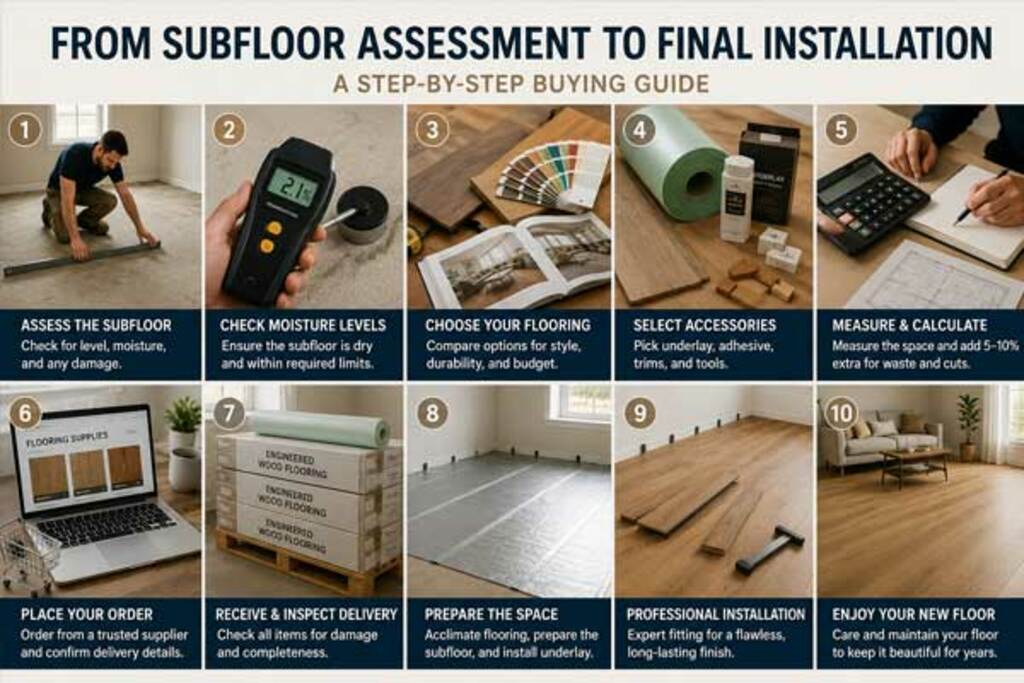
Buying a new floor is a significant investment in a room, or a whole home. Unlike paint or furniture, flooring is difficult and expensive to change once it's down. Getting the decision right the first time comes down to understanding a few practical fundamentals before you start looking at samples.
This guide covers the factors that affect which products will actually work in your space, what the main categories offer, and how to approach the buying process without ending up with something that looks great in the showroom but causes problems at home.
Start With the Subfloor
The subfloor is the structural surface your new floor sits on top of, and its condition and type directly affect which products you can use and how they need to be installed. The two common subfloor types in UK homes are concrete (screed) and timber joists with floorboards or sheet material on top.
Concrete subfloors are common on ground floors and in modern flats. They can work well with underfloor heating, but need to be fully dry before any floor covering goes down. A concrete subfloor with residual moisture above 75% relative humidity (measured with a hygrometer) causes problems for wood and engineered boards. Allow proper drying time, and consider a moisture-tolerant adhesive or a damp-proof membrane underlay.
Timber subfloors have natural movement and some flex, which suits floating engineered wood installations well. Solid wood, nail-down engineered boards, and some adhesive products also work on timber subfloors. LVT generally performs best on a flat, stable surface, so minor unevenness in older timber floors may need a levelling compound before laying.
Understanding Product Categories
Engineered wood consists of a real hardwood top layer — the wear layer — bonded onto a multi-ply plywood or HDF core. The wear layer typically runs between 2.5mm and 6mm. Products with a thicker wear layer can be sanded and refinished more times over their lifespan. Species range from European oak to walnut, with board widths from 90mm to 300mm or more.
Solid hardwood is exactly what it sounds like: solid timber top to bottom, typically 18mm or 20mm thick. It's more sensitive to moisture and temperature change than engineered wood, but with proper acclimatisation and subfloor prep, solid floors are extremely durable. Junckers is the name most associated with pre-finished solid hardwood floors in the UK, particularly for sports, commercial and residential use.
Luxury vinyl tile (LVT) has a rigid or semi-rigid core beneath a printed design layer, topped with a wear layer. It's waterproof, dimensionally stable, and suitable for underfloor heating in most cases. It doesn't have the sound or feel of real wood, but the visual quality at the premium end is genuinely impressive. SPC (stone plastic composite) and WPC (wood plastic composite) are subcategories of LVT with different core constructions.
Installation Methods and Their Implications
Floating installation involves boards that click together but aren't fixed to the subfloor. It's quick, needs no adhesive, and lets the floor expand and contract with seasonal humidity changes. The trade-off: floating floors can sound a bit hollow underfoot, and aren't recommended over certain underfloor heating systems.
Glue-down installation bonds boards directly to the subfloor with adhesive. It gives a more stable, quieter result and is often required for underfloor heating compatibility, though it's more labour-intensive and the floor can't easily be lifted again without damaging the boards.
Secret nailing is used for solid wood and some engineered boards on timber subfloors — a nail gun fixes each board through its tongue at an angle, hiding the fixings from view. It's a traditional method that works well on the right subfloor.
Budgeting Realistically
Floor prices vary enormously. Budget engineered boards start around £20 to £30 per square metre. Mid-range options from quality European manufacturers typically run £45 to £80 per square metre. Premium wide-plank boards with thick wear layers and specialist finishes can reach £120 or more.
Don't calculate your budget on product cost alone. Add the cost of appropriate underlay or adhesive, any subfloor prep work, installation labour (typically £15 to £25 per square metre for a straightforward job), and finishing accessories such as beading, thresholds and stair nosings.
- Measure accurately and add 10% for cuts and waste
- Order a little more than you need for future repairs
- Allow drying time if a levelling compound has been applied
- Acclimatise wood products in the room for at least 48 hours before fitting
- Confirm underfloor heating compatibility before purchasing
Questions Worth Asking Before You Order
Before committing to a product, find out whether it suits your installation method and subfloor type. Ask about warranty terms and what they require in approved adhesives, underlay and installation methods. Find out whether it's in stock or on order, and what the lead time looks like. And ask whether matching accessories — beading, thresholds, stair nosings — are available in the same colour and species.
Flooring is one of the more permanent decisions you'll make in your home. Taking the time to ask the right questions, compare samples properly, and understand the full cost of the project is time well spent.